A Loyalty Program in Practice: How Mimóza Doubled a Day
Written by Jakub Pitoňák
Most venues handle marketing like this: design a nice poster, put it on Instagram, then wait and see who the algorithm reaches. Success gets measured by feel. It was busy, or it was not.
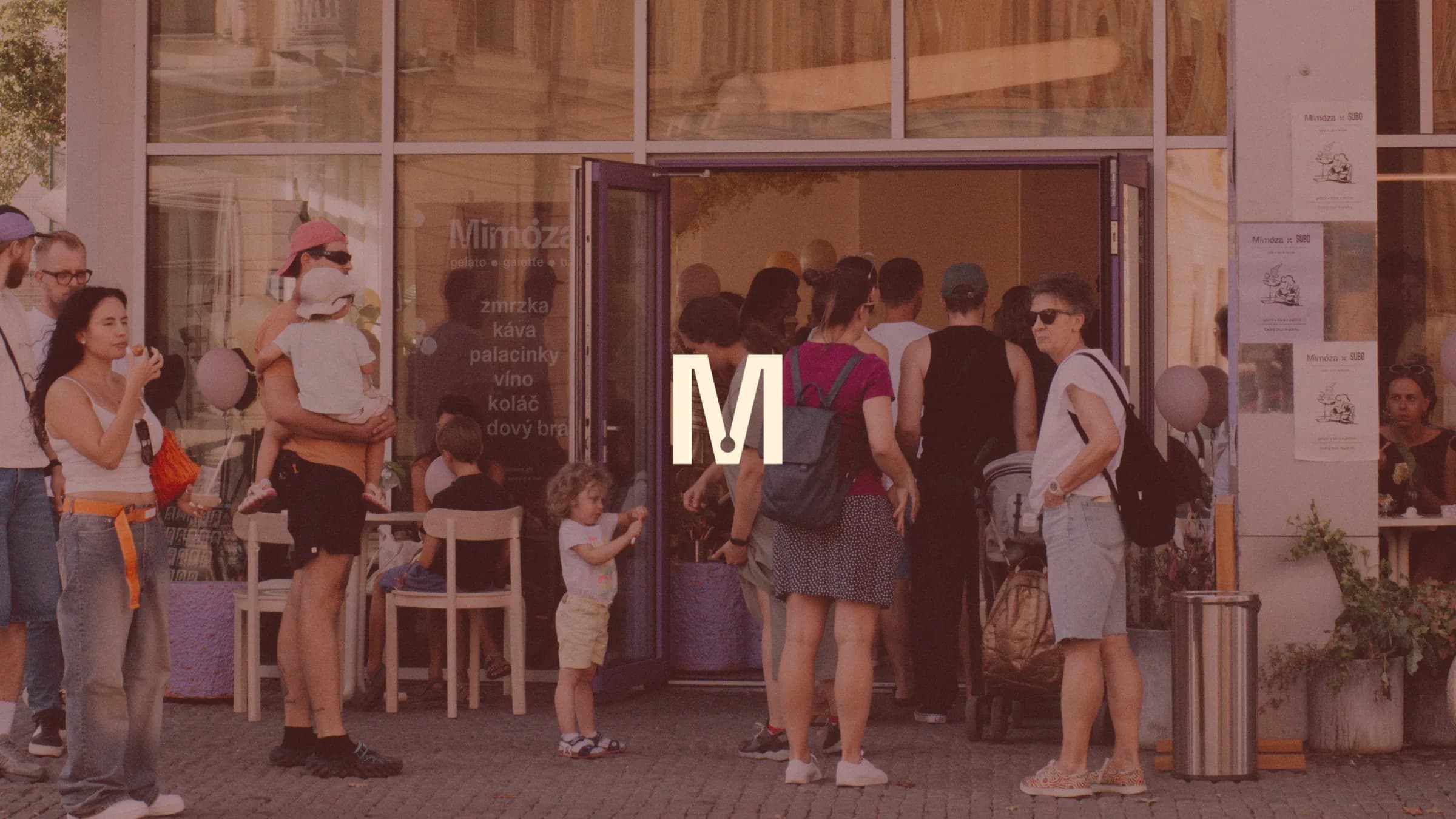
This article shows what a loyalty program looks like in practice when it is used not just to collect stamps but as a direct marketing channel to a venue's own customers. It covers a real campaign we prepared and sent for Mimóza, a gelateria on Dunajská street in Bratislava, for its third birthday.
The division of labour matters here. Mimóza designed the programme and the posters, in their own colours and typeface. We supplied the system: cards in Apple Wallet and Google Wallet, push notifications, the email side, and the data that makes a campaign measurable afterwards. Every number below comes from live production data on the VEXiON cards platform. Nothing here is an estimate.
What we launched for Mimóza
The programme did not arrive all at once. It was assembled in stages, as the venue worked out what it actually needed:
| When | What was added |
|---|---|
| December 2024 | stamp cards, the classic collect-per-visit mechanic |
| March 2025 | a coupon card |
| December 2025 | gift cards |
| June 2026 | a discount card |
Today the venue runs six active cards across four different mechanics. None of it had to be decided on day one, and we recommend the same order to every new venue: start with a stamp card, because every guest understands it instantly, and add the rest only when there is a reason to.
The loyalty notifications that go out without you
This is the part we consider more important than the event itself.
An event campaign is the visible spike. It needed preparation, two emails and one notification. But most of the communication going out from Mimóza to its customers requires nothing from anyone.
Every morning, automated messages go out based on what that day means in each customer's calendar:
Všetko najlepšie k meninám, Zuzana 🎉 Prajeme Vám krásny deň 🌸
🥳 Nezabúdame na Vaše narodeniny, Andreas. Pripomíname si ich spolu s Vami 🎂
Since the start of July 2026, that has meant 31 name day greetings and 17 birthday greetings, each addressed by name, to a specific person, on their day. The system knows the customer's language too, so the same greeting goes out in Slovak or in English.
Nobody writes them. Nobody sends them. They were configured once.
One detail of tone is worth noticing. The automated greetings use the formal register in Slovak, while the anniversary campaign was consistently informal. That is not an inconsistency. A recurring courtesy message can afford some distance; an invitation to a party cannot.
The event campaign: three channels, three days
The campaign was not one big push. It was three touches across three consecutive days, each with a different job.
Sunday 9 August, evening, email. An invitation with the subject line "Máme narodeniny a bez teba to nebude ono" (we have a birthday and it will not be the same without you). Email carries context: the programme from morning to evening, the address, the tombola and the wheel of fortune.
Monday 10 August at 16:00, wallet push notification. One sentence on the lock screen:
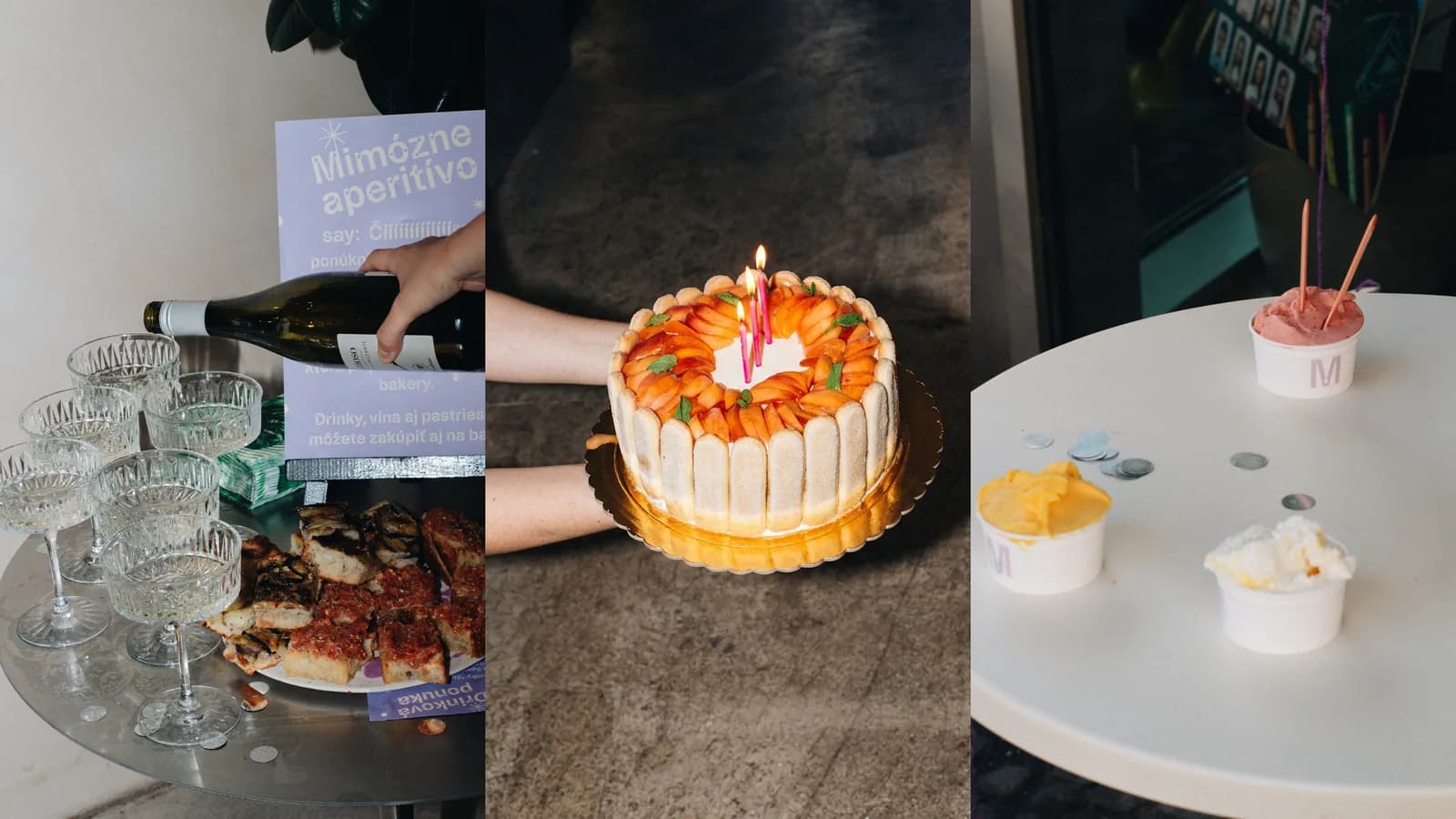
🎉 V stredu 12.8. máme narodky na Dunajskej! Tombola, koleso šťastia, zmrzkové špeciály a od 17:00 prosecco na nás 🥂
That message was delivered to 2,192 of 2,462 phones, a 89 percent delivery rate. It went through no paid advertising and competed with no algorithm. It landed on the lock screens of people who had saved the Mimóza card to their wallet themselves.
Tuesday 11 August, morning, second email. A reminder with the subject line "Zajtra to u nás žije. Oslav to s nami." (tomorrow this place comes alive, celebrate with us).
| Channel | Delivered | Opened |
|---|---|---|
| Email, Sunday invitation | 1,739 | 959 (55.1%) |
| Email, Tuesday reminder | 3,679 | 1,765 (48.0%) |
| Wallet push, Mimóza | 2,192 | 89% delivery rate |
| Wallet push, SUBO | 754 | 84% delivery rate |
| Total | 8,364 | 50.3% on email |
All three touches went out inside three days, and each did the thing it is best at.
Push has the highest reach. It was delivered to 89% of devices and landed straight on the lock screen. No spam folder, no competing for attention against dozens of other messages. If you need something to reach people today, this is the most reliable route.
Email carries the whole story. The programme, the times, the partners, the photos. And at a 50.3% open rate it is plainly not a channel people ignore. They read it about twice as readily as the hospitality field considers normal.
Together they produced a day with double the usual traffic.
Why the newsletter opened that well
The right-hand column deserves its own section, because it is the most surprising result of the whole campaign.
More than half of the delivered emails were opened. 55.1% on the Sunday invitation, 48.0% on the Tuesday reminder. A typical hospitality newsletter sits well below that, so this is roughly double what the field considers normal.
The reason is not the copy or the subject line. It is who the email went to.
An ordinary newsletter list is built from a website form, a competition entry or a bought database. Most of those people no longer remember why they signed up. This list was built differently: these are people who stood at the counter, bought a gelato, and saved the venue's card to their own phone. Every one of them has a real relationship with Mimóza and knows exactly why it is writing to them.
Which leads to the thing most venues overlook: a loyalty programme is not only about stamps, it is also the highest-quality email list a venue can build. You do not buy it or run a competition for it. It grows by itself every time you issue a card. On the day of the event it grew by another 20 people.
For a venue that leads to something very practical: this is a channel you do not pay for twice. Reach on social media is bought again with every post. This list you already own, and you can reach it whenever it matters, whether that is an event, a new flavour or a quiet Tuesday that needs moving.
One Wednesday in August
On Wednesday 12 August 2026, Mimóza recorded 152 loyalty card scans from 121 distinct customers.
For that number to mean anything it needs a comparison. Across the previous 21 days the venue averaged 74.6 scans and 61.4 customers per day. The event day therefore delivered 2.04 times the scans and 1.97 times the customers of a normal day.
| Metric | Normal day (21-day average) | Wednesday 12 Aug | Difference |
|---|---|---|---|
| Card scans | 74.6 | 152 | 2.04× |
| Unique customers | 61.4 | 121 | 1.97× |
| New loyalty signups | about 6 | 20 | more than 3× |
The second strongest day in the same period had 102 scans. The Wednesday beat it by half.
What actually happened that day
A daily total will not tell you whether the campaign worked or whether it simply rained and people wanted ice cream. For that you have to look at the hours.
The poster and both email invitations promised one specific thing: prosecco on the house from 17:00, cake and music. The distribution of scans across the day looked like this:
| Hour | 11:00 | 12:00 | 13:00 | 14:00 | 15:00 | 16:00 | 17:00 | 18:00 | 19:00 | 20:00 |
|---|---|---|---|---|---|---|---|---|---|---|
| Scans | 14 | 12 | 15 | 12 | 3 | 17 | 30 | 20 | 12 | 12 |
The strongest hour of the entire day was 17:00, exactly the hour the messaging promised. Between 16:00 and 20:00 the venue recorded 91 of the 152 scans, which is 60 percent of the whole day.
That is the difference between "it was busy" and "we know people came because we told them to".
Who actually showed up
This is the part a poster can never tell you. Because every scan is a record tied to a specific card, you can break down exactly who walked in that day.
Of the 121 customers who scanned a card on the Wednesday:
- 74 regulars (61%) who had also visited during the previous 30 days
- 23 completely new people (19%) scanning a card for the first time ever
- 24 returning customers (20%) who had not visited for at least a month
That third group is the commercially interesting one. The median absence was 61 days. One of them came back after 474 days.
That is a customer the venue had effectively lost, brought back by a single notification on a lock screen. Without a loyalty programme you could not have reached them, because you would not have known they existed, and you would not have known they returned either.
On top of that, the same day added 20 new loyalty signups against a normal average of around six. A one-off event also became a pipeline of people you can still write to a year from now.
The numbers say how many people came. Katka from Mimóza described how it felt in the room:
Completely different people. A completely perfect atmosphere. The games we had worked incredibly well, everyone enjoyed them. We had two cakes, so we cut them during the two biggest waves.
Those two waves match what the data shows: the strongest hour was 17:00, and sixty percent of the day happened between 16:00 and 20:00.
Two venues, one invitation
The last part of the campaign is the least conventional.
Eight hundred and fifty metres from Mimóza, in the underpass at Hodžovo námestie, sits a bakery called SUBO. They are two separate businesses, each with its own loyalty card and its own customer list. 144 people carry both cards in their wallet.
SUBO supplied the aperitivo at the party. That meant this was never a case of one venue sending its customers to a competitor. SUBO wrote to its own customers about where SUBO itself would be on Wednesday evening, in its own voice and its own style:
🖤 V stredu berieme aperitivo na Dunajskú! Mimóza má narodky, od 17:00 prosecco, torta a DJ. 10 minút z Hodžka ✌🏼
That single message delivered another 754 invitations to phones belonging to people who may never have heard of Mimóza, and it cost nothing.
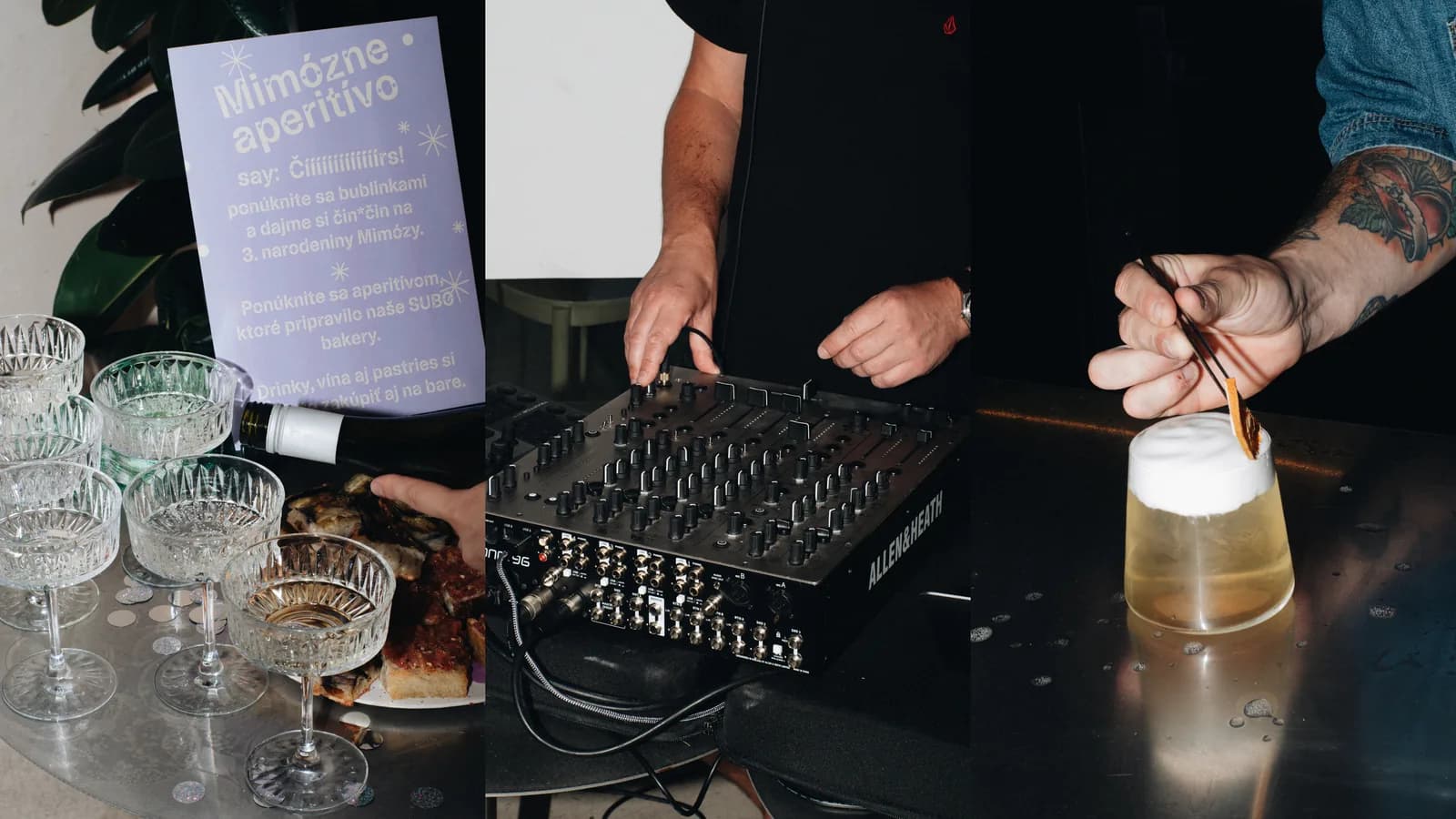
This is also the cheapest way two venues can lend each other an audience. Each one owns a list of people who saved its card by choice, and a single message can connect those two worlds in a matter of minutes. No ad budget, and no need to compete for the same customer.
What to take from this
If you run a cafe, a bakery or a restaurant and want to repeat this, the following holds:
- Promise one specific thing at a specific time. Not "come celebrate with us" but "prosecco on us from 17:00". The strongest hour of the day was exactly the one printed on the invitation.
- Split the campaign into three touches. An email with the programme a few days ahead, a push the day before, an email on the morning of. Each channel does what it is good at.
- Do not overdo notifications. Two per event is enough. A customer who removes the card is a channel lost for good.
- Look at data after the event, not at your impression of it. Splitting visitors into regulars, new and returning tells you whether you brought in new people or simply rewarded the ones who would have come anyway.
- Let the automation run. Name day and birthday greetings are the cheapest form of regular contact a venue has, and they require no work at all.
- Test your greeting against a missing name. In both emails the greeting is written as
Ahoj {{first_name}}with no comma, deliberately. If a record has no first name, the message opens with a clean "Ahoj" instead of a mangled "Ahoj ,". It is a detail only the person with the missing name will ever notice, which is precisely the customer you know least well.
It is not cards, it is a system
In one sentence: a loyalty card is not a system for collecting stamps. It is a list of people who gave you permission to contact them, plus a channel to reach them without paying for every impression.
And it works the other way round too: the same list that fills the room on the day of an event is, for the rest of the year, the best newsletter list you have.
Mimóza has had that channel running for eighteen months. Most of the time it does nothing visible, just wishes a few people a happy name day each morning. But when the venue needed to fill one specific Wednesday, the same channel delivered 8,364 messages and brought in double the usual traffic, including 24 people who had not been in for months.
That is the whole difference between a paper stamp card and a system that helps a business grow.
Want the same programme for your venue? Launching takes one working day: design the card, set the reward, print the QR code for the counter. See the pricing or get in touch and we will walk through a specific scenario for your business.
If you would rather read the detail first, continue to the loyalty card for cafes, the loyalty programme for restaurants, or the overview of digital loyalty cards and their types. POS connections are covered in the integrations overview.