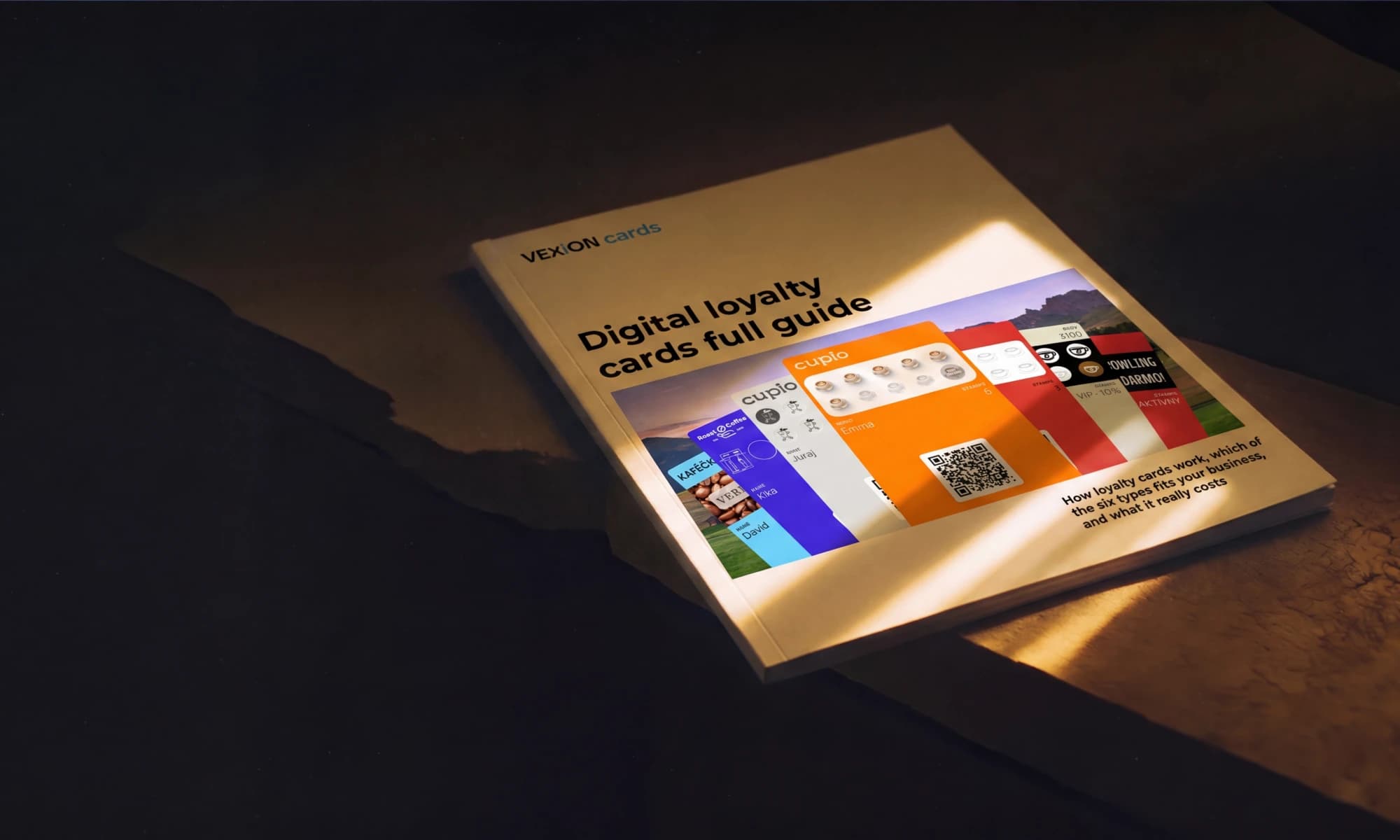
Digital loyalty cards full guide
Written by Jakub Pitoňák
A digital loyalty card is a card in Apple Wallet or Google Wallet that the customer adds to their phone via a QR code. It works at the counter, the reception desk, the wellness studio, and the retail shelf. No app, no lost paper cards. In this guide you'll see how a 2026 loyalty program actually works, which card type fits your business, and what it costs in practice.
- The card adds to the phone in 30 seconds
- Stamps or points are added at every visit
- Push notifications are free, unlike SMS
- Works with Dotykačka, Storyous, Papaya, and OBERON
Whether you run a cafe, a restaurant, a fitness studio, a salon, or a retail shop, the principle is the same. This article shows how it works for different business types, what to watch out for, and how a loyalty program becomes part of regular operations rather than another headache.
Why paper stamp cards are no longer a real option in 2026
Walk past any cafe, salon, or shop. At the counter there's almost always a small stack of crumpled cards. Some get lost. Some get wet. Some sit at home and the customer doesn't remember to bring them. They leave behind the impression that the program is interesting in theory but pleases nobody in practice.
Plastic cards are slightly better but still impractical. They take up wallet space, cost real money to produce, and end up lost too. And critically: neither paper nor plastic tells you who your best customers are, how often they visit, and what they buy. Without that information, marketing happens blind.
A digital card on the phone removes these problems. The customer always carries it. You see every visit in the dashboard. Both sides save time at the counter.
Key takeaway:
- Paper and plastic cards both get lost and collect no data
- Mobile wallet is on every modern customer's phone
- A digital card gives the operator a view paper and plastic cannot
How a digital loyalty card works step by step
At the first visit. The customer scans the QR code at your counter or on the table. They fill in name and email. The card saves to Apple Wallet or Google Wallet. Less than a minute.
At subsequent visits. The customer shows the card from the phone. Staff scan it. A stamp or points get added. Done.
When the card is full. The customer gets a notification on the phone about a ready reward. On the next visit they redeem it with one click.
The card always needs physical contact with a scanner or POS so the specific customer is identified. With POS integration (Dotykačka, Storyous, Papaya, OBERON), the count of stamps or points is calculated automatically based on the bill amount. Staff no longer have to manually decide how many points to credit. Without integration, staff enter the count manually when scanning. The difference is speed, not whether the card gets scanned.
The six card types and who each one fits
A loyalty program works differently for different businesses. We've summarized the six main types and where each one performs best.
Stamp card. The classic everyone knows.
"Buy 9 coffees, the 10th is on the house." Simple, predictable, proven by decades. For cafes, bakeries, car washes, and other businesses with a stable menu, it's the easiest and most predictable model.
Points card. Flexibility for a wide menu.
In a clothing store, bookshop, or restaurant, every customer buys something different each time. Points solve this. Ten points per euro spent, a thousand points lets the customer pick a reward they actually want.
Cashback card. Returning a share of the spend.
The customer earns a percentage cashback on every purchase. It accumulates on the card as credit and gets used on the next visit. Works in retail, hospitality, and services where there's room for a repeat purchase.
Tiered discount card. Rewarding the most loyal.
The more the customer spends with you, the higher the discount. Bronze 5%, Silver 10%, Gold 15%. Works in boutiques, wellness, premium services. People like the feeling of stepping up a level.
Membership card. Predictable revenue for you.
Monthly, six-month, or yearly membership with benefits. Fitness cards with unlimited entry, club cards with exclusive offers, breakfast subscriptions for corporate clients. Predictable revenue for the business, perks for the customer.
Gift card. Cash today, visit later.
Someone wants to gift dinner at your restaurant, a massage at a salon, or shopping at your store. You sell a digital gift card, the recipient gets it on their phone, you have the money immediately. Often you also gain a new customer who would not have come otherwise. More in the digital gift cards article.
Key takeaway:
- The stamp card is the easiest to launch for any business
- Points and cashback cards fit a broad menu
- Membership and gift cards open new revenue models
How to connect the loyalty program to your POS
VEXiON cards integrates natively with the point-of-sale systems most Slovak and Czech venues already run:
- Dotykačka, the most widespread in Slovak hospitality. Setup is in our Dotykačka integration guide.
- Storyous, popular in modern cafes and bistros. The path is described in Storyous integration.
- Papaya POS, strong in the restaurant segment. More in our Papaya integration article.
- OBERON, fits smaller venues and traditional setups. Details are in OBERON integration.
If you don't run any of these, or run no POS at all, the program still works. You scan cards via a QR scanner connected to a tablet or via a regular smartphone with the VEXiON cards app. Launch takes one business day.
Push notifications as quiet, free marketing
Push notifications from a digital card show on the phone's lock screen, similar to SMS. The open rate is significantly higher than email. And unlike SMS they're free, no matter how many you send.
The most effective scenarios in practice:
- Geo reminder. A customer walks past your venue and the phone shows an invitation to stop in.
- Birthday. A few days before the birthday you send a personal greeting with a small gift. The customer rarely comes alone.
- Win-back. A customer hasn't visited in 30 days. You send an invitation with a discount on the next visit.
- New products. A short heads-up when you launch a new item or seasonal promotion.
What not to do: send generic messages every two days, send notifications before 7 AM, address customers as "Dear customer" instead of by first name. Notifications need to be relevant, well-timed, and personalized. Otherwise the customer mutes them and the card loses one communication channel.
Key takeaway:
- Geo and birthday notifications get the highest engagement
- At most once a week so customers don't mute the channel
- First-name personalization lifts open rates and clicks
You see exactly who your best customers are
In the VEXiON cards dashboard you see every visit, every card, every reward in real time. Who spent the most with you in the last month. The average ticket of a regular customer. Which reward motivates people most. Paper cards can't give you this and plastic cards only partially.
Every customer has a profile: name, email, phone, visit history, favorite products. You can send them an event invite, a thank-you notification on their hundredth visit, a special offer for the top ten. From a paper card you can't.
Data exports to Excel or your accounting system at any time. No vendor lock-in, no friction if you ever migrate to another platform.
What it costs and when it pays back
VEXiON cards has two main plans:
- VEXiON ONE from €20/month. For single-location businesses starting with a loyalty program. One card type, push notifications, basic analytics, Apple and Google Wallet.
- VEXiON PRO from €45/month. For growing businesses with multiple locations. Unlimited cards and customers, POS integration, geo notifications, advanced analytics, online and physical gift cards. With multiple locations, pricing is graduated (a tiered discount from the second location).
For franchises and multi-brand chains, VEXiON CUSTOM offers a dedicated manager and custom integrations. Current pricing is on the pricing page.
In practice, the investment in a loyalty program typically pays back in two to four months. It depends on the type of business, visit frequency, and how actively you communicate the program to your customers. The most accurate calculation is a specific look at your business: our piece on setting up a loyalty program includes a calculator where you can enter your own numbers.
The most common mistakes when launching a loyalty program
Rules that are too complicated. "10 points per coffee, 15 points per cake but only on Mondays, 237 points equals a €3.50 discount on selected products." Nobody understands. The rule must be sayable in one sentence.
Weak rewards. Five percent off after 20 visits motivates no one. The reward needs to be reachable in a reasonable time and worth real value to the customer.
No promotion. A QR code placed at the counter is not enough. Staff need to be able to talk about the program. Customers need to receive an email after their first visit. A standee at the entrance helps.
Ignoring data. You have a beautiful dashboard and never look at it. Ten minutes once a week is enough. Who are the top customers, which rewards work, when are visits highest. You make decisions from this.
How to launch a loyalty program in one business day
Morning: decision and signup. Pick a card type based on what you want to achieve. More visits? Higher spend? New customers? Sign up at vexioncards.one/start. Fill in details, upload a logo, choose colors. 15 minutes.
Afternoon: program setup. For a cafe, 10 stamps equals a free coffee. For a shop, one euro equals 10 points. For wellness, a tier system with three levels. Print the auto-generated QR poster and place it where it's visible at the counter and the entrance.
Day two: training and first cards. Staff need 5 minutes of training. On the first visit they scan a customer's card, you see the first add in the dashboard. After a week you have a realistic picture of who's adding cards, how many there are, and which rewards are interesting them.
Common questions
Does it work without a modern POS?
Yes. VEXiON cards works standalone with a QR scanner connected to a tablet or with a regular smartphone running the app. Integration with Dotykačka, Storyous, Papaya, or OBERON is an extension that saves staff time, but not a precondition.
What if a customer doesn't have Apple Wallet or Google Wallet?
Apple Wallet and Google Wallet are pre-installed on virtually every smartphone shipped after 2017. In rare cases (older phone) we can issue a physical PVC card with an NFC chip. It works the same way at the counter and lasts for years.
Which card type should a brand-new business pick?
For a new business we recommend the classic stamp or points card. They're the easiest to explain, the easiest to implement, and have predictable economics. After six months you have enough data to decide whether to add another type.
When will we see results?
You'll see card adds within 24 hours of launch. Real impact on return visits is measurable in the dashboard after three to four weeks, when you have enough data to compare against the period before launch.
Wrap-up: A loyalty program is a relationship, not a tool
A traditional stamp card is a technical add-on at the counter. A digital card on the customer's phone is something else. It's a way to maintain the relationship between your business and a guest even when they're not sitting at your table. It's a nudge as they walk past. A small surprise on a birthday. A reason to pick your venue out of all the venues in town.
Loyalty programs in 2026 are no longer about stamps. They're about whether you know who your customers are, how to approach them, and whether you make their life simpler instead of more complicated. The ones who do it deliberately stay. The rest hunt for lower rent in a different city.